Top Image

Top Image

Junking 101: Turquoise

Posted on: Friday, February 20, 2015

For those of you addicted to the vintage treasure hunt, we bring you our series on knowing a bit more about your valuable finds. Junking 101 posts will focus your eye in on items that have stories to tell in history, and when to spot a truly unique lovely! It's gold, Jerry!
Western iconography carries within itself much more than a simple dollar value. The connotation of nostalgia, beauty, adventure, and nativity has seeped into the pores of objects such as cow skulls, indian trade blankets, cowboy boots, and cacti. They hold within themselves dreams of open roads with the windows down, dry wind whipping undone hair as you take in the majestic nothingness of the deserts, watching the background mesas slowly turn to snowcapped mountains in the distance. And the exploration of finding gems in the deserts, of wandering somewhereor nowherethe West doesn’t ask for decisions, it just beckons you come.


So when we happen upon treasures reminiscent of our beloved Southwest, it is easier to evaluate its dollar amount congruent with the feelings evoked in the treasurer—but what about its market value? What, exactly, are we looking at? We traveled to the High Noon show in Mesa, Arizona, where experts of all things Western come to share their finds and collectors come to admire them. Original saddles and trade blankets going for thousands of dollars, leather goods alongside silver goods, and what we are illuminating today: turquoise. With the vast array of hues, textures, and shapes this one mineral can come in—we wanted to know more.

And so we found out.


We found out the popularity of this mineral reaches further back and spreads wider than we expected. It carries deep meaning in cultures all over the world. And there are so. many. colors.


Before there was the West, there were Egyptian graves and Persian Empires. Ancient Egyptians inlayed turquoise in grave furnishings; and ancient Persians wore the sky-blue variety around their necks to protect against unnatural deaths (if the stone began changing color, it was a sign of doom for the wearer—dun dun dun). Later on, Europeans imported these gemstones from Turkey, gaining their name from the French word for Turkish, turquoise. From there, the name then spread to encompass the blue-green color (synonymous with the stone) as well. Only gold, silver, and copper carry the same promiscuity of being so commonly used for the color the mineral represents (think Kleenex for tissues, or Xerox for copy machines—turquoise sure branded itself well).


And now we journey to the Americas.

Native Americans really valued turquoise, trading the rough gemstones as well as turquoise objects even down into South America. Worn on the body or for ceremonial purposes, they believed turquoise signified the god of the sky was alive in the earth. It wasn’t until the nineteenth century that they began pairing coin silver with it to fashion their jewelry (a stroke of genius!) an this giving birth to the now famous duo: sterling silver and turquoise.

What has made us all, for thousands (and thousands) of years, prize and popularize turquoise? It’s primarily due to its color—blue gemstones are quite rare on this planet. But within this one color, there are numerous variations due to the chemical elements that make up the mineral. Turquoise is a hydrous phosphate of copper and aluminum, meaning water seeps into the picture (a.k.a. underground), and magic happens. Or, rainfall soaks into the ground and dissolves small amounts of copper, which then dries, mixes with phosphate and aluminum, and leaves deposits of turquoise in fractures underground. If you’ve ever noticed the beautiful blue-green patina oxidized copper produces, you’ll understand—magic! 


Pure goodness is when the chemical process produces the most desirable turquoise: sky, or robin’s egg blue. From there, other elements come into play to produce different hues of less desirable color: blue-green, yellowish-green, stones with brown/black spider webbing, or patches of brown/black. When bits of iron substitute themselves for aluminum in the recipe, the result is always greener—the green tint is directly proportional to the amount of iron imparted. And then there is the host rockor matrixfor you geology buffs. When the host rock gets entangled in the process, the spidery veins and patches form in turquoise. Though many cutters will do their best to cut these ‘impurities’ out, often they are unavoidable. And besides, some of us like seeing the matrix mixed with the bright blue—one of those “perfectly imperfect” kind of situations.


Arid climates cultivate the best conditions for turquoise formation (think the Southwest region of the USA, China, Chile, Egypt, Iran and Mexico). The leading producers of turquoise in the States today are Arizona (number one), New Mexico and Nevada—with second string mines in Colorado, California, Utah, Texas and Arkansas. Those who know their turquoise can often identify the place and/or mine in which a specific stone originated. Which is additionally impressive, especially considering turquoise can change color over time, from exposure to light, cosmetics, acidity from our skin, and/or dust—nature’s great mood ring. Since turquoise isn’t found as one solid crystal, rather as an aggregate of micro-crystals packed together, its porous character makes it more susceptible to these environmental influences. Which also gives turquoise its waxy—as opposed to glassy (like gold or diamonds)—luster.


When shopping around for turquoise, beware of the cubic zirconia (a.k.a. impostor) version—its synthetic antithesis. Both foreign (mainly Russia and China) and domestic (Gilson Company) producers have made glass, plastic, and ceramic look-a-likes since the seventies, damaging the market. These materials are often died blue, so a simple scratch will reveal whether it’s genuine turquoise or only skin deep. But if you happen upon a piece of genuine turquoise, you possess talisman teeming with luck, success, ambition, and creativity. 

So what turquoise stone types catch your eye—the smooth blue, the patchy blue-green, the chocolate brown matrix?

Junking 101: Pendletons

Posted on: Monday, August 25, 2014

“We have lost much of the past in this country ,and tradition is no longer an easily found commodity, but tradition is alive and well at Pendleton. A pioneer Oregon family continues to manufacture the blankets their ancestors produced specifically for sale to American Indian men and women. A Navajo woman still dances to ancient rhythms in her Pendleton shawl. A Zuni family still bury a loved one in a jet black Pendleton robe. The tide of history washed away the last of its competitors many, many years ago. Pendleton alone remains.”
-Barry Friedman


All photos are from Friedman's Chasing Rainbows

“Life if perfect with a Pendleton!” is Sharpie-inscribed above Barry Friedman’s signature inside a copy of his book, Chasing Rainbows: Collecting American Indian Trade & Camp Blankets. If you have spent any amount of time scouring fleas and thrift stores for items made by this coveted brand, the moment you happen upon one, life does feel pretty perfect. And from decades of collecting these woolen wonders, he knows the feeling well. Though Pendleton’s name carries weight for many of us—sparking notions of bright, geometric patterns concomitant with Native American traditions—their inherent value goes much deeper than current trends and tastes. The tale of Indian trade blankets weaves together the white man and indigenous tribes into a symbiotic relationship after the Indian Wars that carries on through today. If you’re looking for a truly vintage Pendleton, and need a good lens to filter see through the loads and piles of blankets, read on before your next shopping trip.


The Indian Wars results forced independent Native American tribes onto undesirable reservation lands, at the mercy of government aid. Having penned free, nomadic spirits in foreign land, the Native American way of life would be forever changed. Around 1890 Traders settled on reservations, selling trinkets and wares of the West to white consumers as they traveled through, except for the Indian trade blankets, these were made exclusively for the Native American consumer, who used them for dress, sleep, burial robes, etc. At this same time, the Navajo began weaving rugs to sell to traders. So Anglo made blankets designed for Indians’ use and Indian made rugs designed for Anglo homes flooded trading posts and woolen mills manufacturing trade blankets began to sprout.


There were many competing companies with their own distinctive patterns and weave from 1890-1942, but Pendleton Woolen Mills outlasted them all as the only surviving manufacturer of Indian trade blankets, and made more than all the other mills combined. The company got their start in 1896, and more than one hundred years later, we still want one. With a deluge of their blankets, robes and couch covers out on the market, developing a collector’s eye takes talent and work. We are here to get you started. Though this post is hardly comprehensive in it’s overview of how to spot a highly valuable blanket, it will get you shopping more keenly and understanding more clearly what a truly vintage Pendelton is (for more detailed information, check out Barry’s incredible book, Chasing Rainbows, to start—an enjoyable and fascinating read).


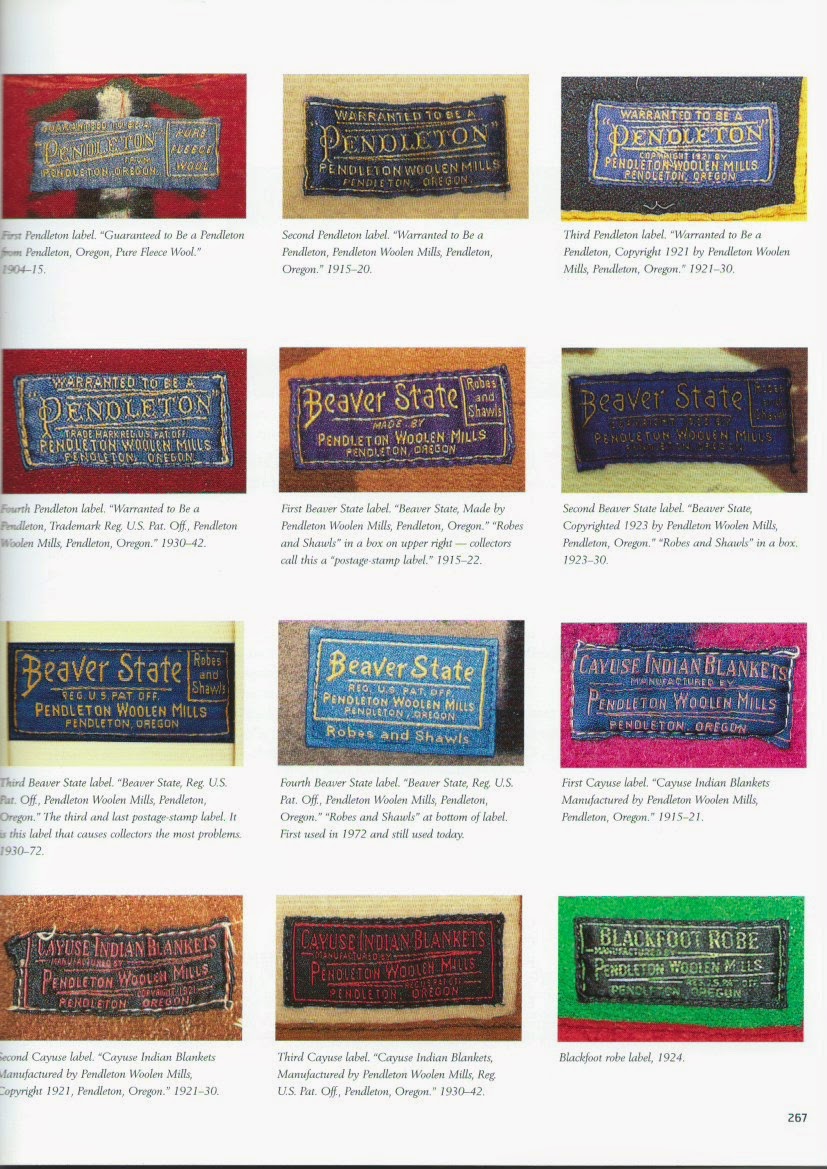
The first blankets turned out by Pendleton Woolen Mills had rounded corners and stopped being produced in 1908—if you find one of these, “Eureka!”, you’ve struck gold. These are the most valuable Pendletons. A word of caution, though, Knight Woolen Mills also made round corner blankets, and a Pendleton from 1896-1904 will most likely bear no label (few survived as they were made of cardboard). Find one with a cloth label reading “Gauranteed to be a Pendleton-Pine Fleece Wool,” you can rest assure that blanket was made between 1904-1908, and you should give Barry Friedman a call.

Joseph Rawnsey began working for Pendleton under an ownership change in 1901, and remained their cornerstone designer until his death in 1929. His ability and talent being unsurpassed, blankets made during these years are highly coveted (next only to the round corner blankets): specifically the spectacular, vibrant-colored patterns from the 1911 sales catalog—Pendleton’s first full color catalog. Two of his designs, the Harding and the Chief Joseph patterns still remain in Pendleton lines to this day.


Pendleton Woolen Mills lived up to their slogan, “Where quality decides we always win,” making their blankets from virgin wool and processing the wool with house made soaps. For a few years they wove for the Cayuse Blanket Company in the 1920’s, making a more inexpensive version with cotton warp and 17% reprocessed wool.


Fringe or no fringe: shawls are the fringed blankets intended for women and blankets sans fringe were made for men and called robes. Neither one is more or less valuable than the other, but a couch cover will trump both. Color schemes can hype value, too, with bold primary colors—black and red being tops—as the most desirable.


Pendleton couch cover

Pendleton trade blankets come in eight different design categories, according to Friedman, in order of most desirable to collectors:


Overall: a repeating pattern fills entire the entire surface of the blanket—this is generally the ‘busiest’ sort of pattern.


Banded: In banded blankets, patter is confined within…duh…bands. Areas of solid color separate the bands from one another.
Center Point: features either an individual design element—usually a cross, star, or diamond—in the middle of the blanket that dominates the pattern or a series of the same dominating elements in a horizontal or vertical band across the blankets center.


Six-Element: features two identical large elements reported in three rows.
Nine-Element: features three identical large elements reported in three rows.


Framed: a single large design element in the center of the blanket is surrounded by solid color. An intersecting design running the length of all four side ore h blanket forms a ‘frame’ for the central element. These are exclusive to Pendleton.
Striped: are just that—stripes and nothing else. Every manufacturer made striped patterns, which have always been a great favorite of all the tribes.
Pictorial: features…yes, that’s right…pictures!

Conditions to be aware of which devalue blankets are shrinkage and pilling. If a blanket is less than five by six feet or if the edges pucker when lain flat, it’s been shrunk. Other marks of wear may add to the value for some collectors, and are referred to as relic condition, while other prefer a blanket in ‘like new’, or mint, condition.

Labels can give you a good indication of when the blanket was made. Familiarize yourself with the evolution of labels below, to give you a good indication of when a blanket was woven.


Here is a quick timeline of dates to help place blankets and determine value:
1896-1901: round corner blankets made on dobby looms with only straight line patterns
1901: Jacquard looms replace dobby looms, allowing for increased intricacy and designs with curvilinear patterns; first Pendleton shawl made
1902: bales of twenty assorted robes sell for eighty dollars
1904-1908: round corner blankets with cloth labels
1908-1909: Pendleton Woolen Mills falls into financial difficulty and mill idles until bought by Bishop family (who still owns it today!)
1901-1929: Joe Rawnsey designs for Pendleton Woolen Mills
1910: Tepee patterned blankets hit the market
1911: Pendleton’s most elaborate catalog issued
1924-1929: Cayuse blankets manufactured
1926: Harding pattern coined
1929: Stock market crashes
1930: Chief Joseph pattern coined; patterns become larger designs with diamond, cross and star motifs, using sunset colors of browns and oranges.
1942: all woolen mills converted to war efforts and marks the end of the Indian trade blanket manufacturing era. Any blanket dated prior to this year is of high value!


Ultimately, finding the perfect Pendleton comes down to what you enjoy, this is the most important value to consider. Whether you collect Pendleton’s as a hobby or just love a good wool blanket as the Winter chill sets in, know that wherever you see one, Native Americans are still using them right alongside you—and may we all find some warmth in kinship through our mutual love of these spectacularly woven trade blankets.

Ruby Rose All rights reserved © Blog Milk Powered by Blogger